
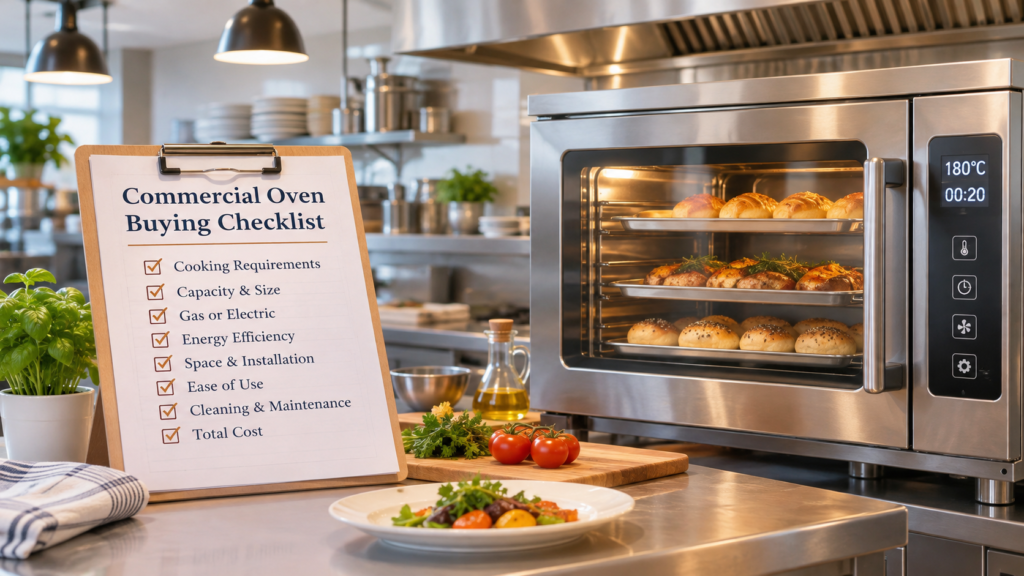
Choosing the right kitchen appliances is significant for each restaurant and hotel owner. A good commercial oven can help to preserve the quality of food, increase the efficiency of the kitchen, and provide smooth service during the rush hours.
However, along with a variety of commercial ovens available in the market in terms of models, sizes, and technologies, it may seem rather complicated to make the right choice.
Before going to buy a commercial oven, one should get acquainted with the needs of the kitchen, the space available, and their culinary and economic requirements.
You will be able to find the list of useful tips below to make it easier for you to choose the perfect appliances for your business.
1. Identify Your Kitchen’s Cooking Requirements
The first step while selecting a commercial oven for your kitchen should be to check the menu options. The needs of a bakery that specializes in bread and bakery products are different from those of a hotel kitchen that specializes in preparing grill items, roasted veggies, and banquet meals.
You need to figure out the recipes you use the most along with the cooking procedures used.
Convection commercial oven: Best for roasting, baking, and cooking a variety of recipes using hot air convection.
Combi oven: A type of oven that combines the steam and convection heating methods for the cooking process.
Deck oven: The most preferred choice to bake bread, pizza, and various bakery products.
Conveyor oven: Useful for the cooking process where the cooking process is continuous, like in busy pizza outlets.
Use your menu to choose the oven as opposed to paying high for features that may rarely be used in your kitchen.
2. Check Capacity and Production Volume
Even if you have an excellent commercial oven during off-peak hours, you may find that it under-performs during busy breakfast, dinner, or banquet periods.
To maximize productivity, figure out how much food you are likely to cook during peak times, as well as how many trays the oven can hold, how large they are, and how fast their recovery time is.
If one typically runs a small café, a small model might suffice, whereas a hotel that caters to large groups will overuse the commercial oven unless it gets a bigger one or multiple models.
It is important to not purchase anything that would be too big or too small for the workload you want to do.
3. Compare Gas and Electric Models
The appliances that you have access to are going to play a role in deciding which option is best for your kitchen.
If you have a constant supply of gas along with good airflow, then gas cookers would be a good choice for you. If you want precise temperature settings, electric commercial ovens could work better in terms of practical arrangements in the kitchen.
Factors to keep in mind when making the choice include installation requirements, the cost of energy, and how energy efficient the equipment will be. Make sure you hire a specialist to check if your kitchen electricity supply can handle the device.
4. Evaluate Energy Efficiency
The energy consumption is an important factor that plays a huge role in the operating costs of a restaurant. Ensure that you find the information about the energy consumption, thermal insulation, temperature recovery, and the energy use while maintaining the standby mode of the equipment. If possible, do the comparison of different values and find the efficiency ratings approved by independent organizations, for example, the ENERGY STAR label.
According to the ENERGY STAR program of the U.S. Environmental Protection Agency, certified commercial ovens are up to 30% more energy-efficient than the regular commercial ovens. However, the actual cost savings depend on the type of equipment being used and its working conditions.
Make sure to check the official guidelines for the commercial ovens provided by the ENERGY STAR program to learn about the efficiency parameters of the equipment.
5. Measure Kitchen Space and Check Installation Needs
Prior to making a purchase, ensure the installation area dimensions are measured meticulously. Factor in the complete size of the commercial oven, including the room for opening the door and employee movement, as well as space available for cleaning and repairs.
It is equally important to verify the following:
The amount of electricity or gas needed.
Ventilation work and fire-safety features.
The arrangement of water and sewage systems.
The possibility of delivering equipment through the doors, elevators, and hallways.
The space required for the installation.
The rules differ based on the model and the area where it’s used. Always talk to people experienced in installation work and clarify the codes and regulations involved before making the final decision.
6. Prioritise Temperature Control and Ease of Use
Cooking consistently is important for customers. Inconsistent cooking or temperature control may be detrimental to food quality and lead to wastage.
Aim for thermostats with good reliability and a clear control system, good cooking programs, and even cooking at a suitable temperature. Depending on your menu, features such as steam injection, programmable options of cooking, or temperature sensors may also be useful.
Also, keep in mind that devices with easy controls would simplify the training of your staff and provide continuous quality food across shifts.
7. Review Cleaning and Maintenance Requirements
In order to be used in a safe and efficient manner, kitchen equipment has to be cleaned from time to time. When purchasing new equipment, make sure to check that racks can be taken out, the inner surfaces are easily washable, and maintenance is simple enough.
Find out what the manufacturer recommends with respect to cleaning procedures, service intervals, spare parts availability, and warranty.
Availability of reliable after-sale services is a significant factor for hotels and restaurants that cannot afford having their equipment out of order for a long time.
8. Calculate the Total Cost Before Buying
The cost of an item is just one aspect of how much it costs you. In reality, your costs will likely include delivery, installation of the item in question, ventilation upgrades, energy use, water use, cleaning supplies, maintenance, and labor costs.
First, get written quotations from suppliers for comparable equipment and check prices for the different models. They must quote for everything in order to know the end price for the specific item. In addition, installation and accessories should be included.
If the cost of the item is a bit higher but the item is also more efficient, requires less effort in terms of maintenance, or is suited for your workloads, then it has greater value.
Final Checklist Before Placing Your Order
- Prior to coming to your final answer, make sure that you have:
- Determined the correct kind of commercial oven to suit your menu.
- Calculated the maximum output needed.
- Verified size and access for installation.
- Checked temperature and ventilation needs.
- Reviewed prices and energy efficiency.
- Checked warranty provisions and service support.
- Compared prices from various manufacturers and the added accessories.
Conclusion
When it comes to buying kitchen equipment, it is important to take the time to think through your options and consider more than just the price and the brand that you are going to buy. Hotel and restaurant owners should take into account the production capabilities of a piece of equipment, how energy efficient it is, and how it should be installed, as well as the costs associated with maintenance and the availability of customer support.
Making the right decision about kitchen equipment means saving time in the kitchen, ensuring that the food served is of good quality, and effectively managing costs on the equipment. Therefore, you should inspect the kitchen equipment of different manufacturers in detail and clarify all your questions with companies before making a decision.