
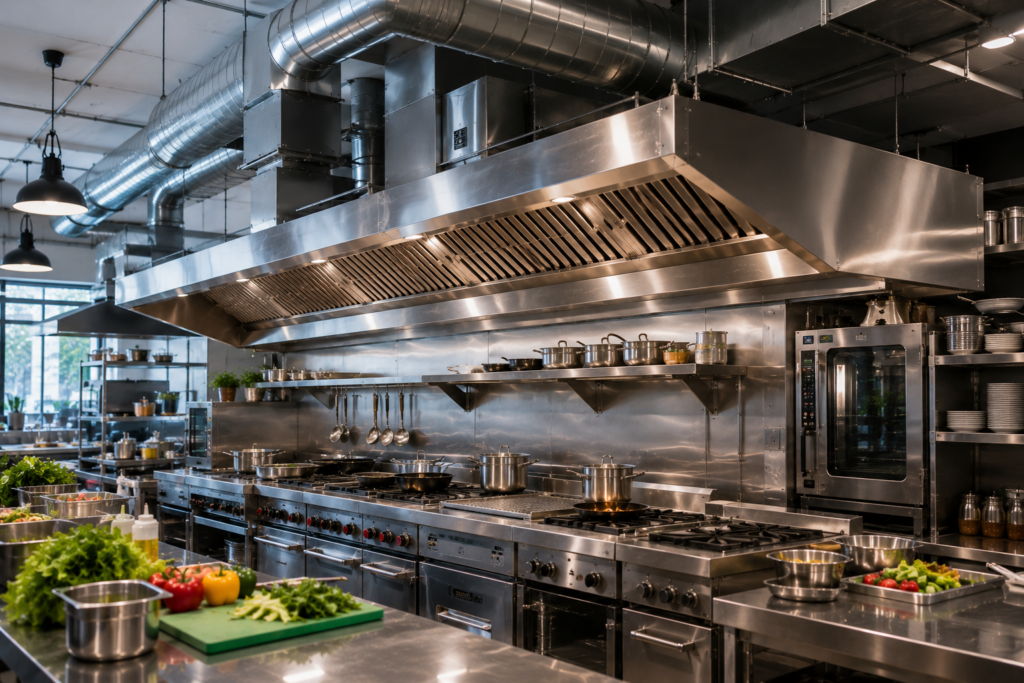
A commercial kitchen ventilation system is one of the most crucial systems in a commercial kitchen. It is responsible for removing smoke, heat, grease, steam, smells, and other airborne pollutants created during cooking processes. Good ventilation creates a more comfortable environment and enables smooth functioning of the kitchen appliances.
If you plan to set up a restaurant, hotel, cafe, bakery, cloud kitchen, or institutional kitchen, selection of the ventilation system should be an important part of the kitchen design process.
What Is a Commercial Kitchen Ventilation System?
Commercial kitchen ventilation systems include all equipment that allows controlling air flows inside a professional kitchen space. The system removes the contaminated air created in the process of cooking and supplies clean air into the kitchen area.
It can consist of the following elements:
- Exhaust hood systems
- Exhaust fans
- Fresh-air or make-up air systems
- Ducts
- Grease filters
- Supply air systems
- Air balancing systems
- Ventilation controls
Why Is Commercial Kitchen Ventilation Important?
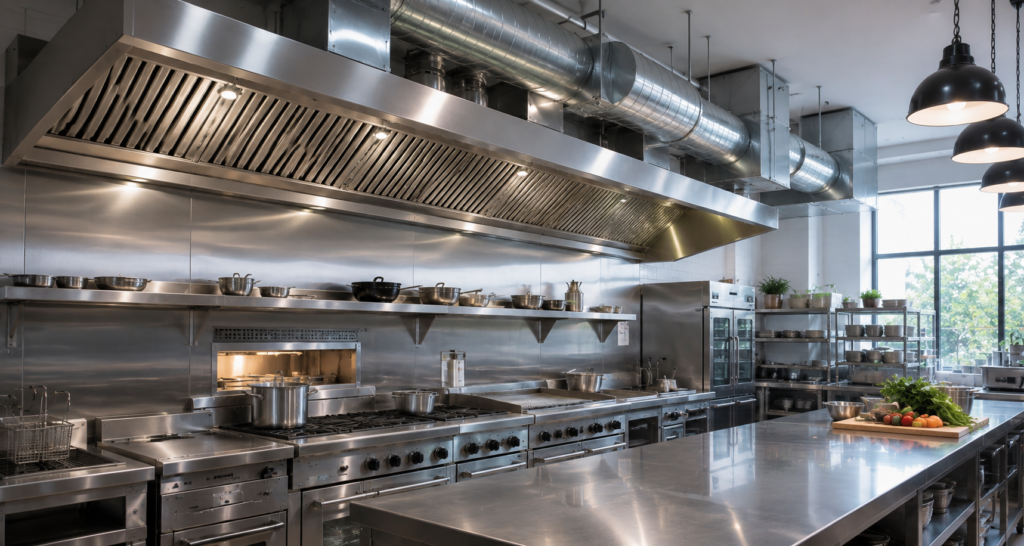
Commercial kitchens produce much higher amounts of heat, smoke, grease, and steam when compared to residential kitchens. In absence of adequate ventilation, such substances tend to accumulate quickly.
Properly designed commercial kitchen ventilation systems bring numerous advantages.
1. Heat and Smoke Removal
Ranges, deep fryers, grills, ovens, and cooking ranges generate heat and smoke. The ventilating hood gathers the exhaust and gets rid of them in the area of cooking.
The result is that the surrounding remains relatively cool for the chefs and other workers in the kitchen.
2. Grease and Cooking Vapors Control
Processes like frying, grilling, roasting, etc. may result in the production of grease particles that enter the air. Grease filters help to capture such particles before the exhaust duct collects them.
Proper grease control also allows to minimize grease build-up within ventilation system elements.
3. Odor Reduction
Preparation of food products can lead to production of unpleasant odors, especially in the case of working restaurants 24/7. Air extraction helps to control cooking odors.
4. Maintaining Indoor Air Quality
Incorporating fresh air intake in addition to an efficient exhaust mechanism maintains good indoor air quality. It becomes extremely important in those commercial kitchens that operate several cooking appliances simultaneously.
5. Fire Safety
Accumulation of grease in the exhaust system poses a big danger of fire in the kitchen. Appropriate exhaust hood design, filtering and cleaning help reduce this risk.
A ventilation system must always be designed and installed in line with all local regulations regarding fire, building, and safety codes.
Components of Commercial Kitchen Exhaust System
Knowing the key components makes it easier to design a system that will suit your needs.
Exhaust Hood
The exhaust hood is mounted above the cooking appliances where it draws heat, smoke, grease, vapors, and steam. The exhaust hood design is based on the type of cooking equipment used.
Grease Filters
Grease filters are located within exhaust hoods and their purpose is to collect grease particles within cooking vapor. These filters protect the exhaust duct and fan from too much grease accumulation.
Frequent inspections and cleanings of the filters are necessary in order to ensure effective ventilation.
Exhaust Fan
An exhaust fan ensures proper ventilation by creating the air flow necessary to remove contaminated air from the kitchen. Fan capacity is selected keeping in view the size of the hood, type of cooking equipment used, design of ductwork, and the required air flow.
Inappropriate fan capacity can result in ineffective air extraction.
Ductwork
Ducts are responsible for carrying extracted air out of the hood. Sizing, designing, choosing material, and installing ductwork properly is very important in ensuring proper air flow.
Wrong ductwork design may create unnecessary air resistance.
Make-Up Air System
While the exhaust fan extracts air from the kitchen, there is a necessity for new air to be brought in. A make-up air system is designed to bring in replacement air to replace extracted air.
Lack of replacement air leads to creation of too much negative pressure in the kitchen.
Types of Commercial Kitchen Ventilation Systems
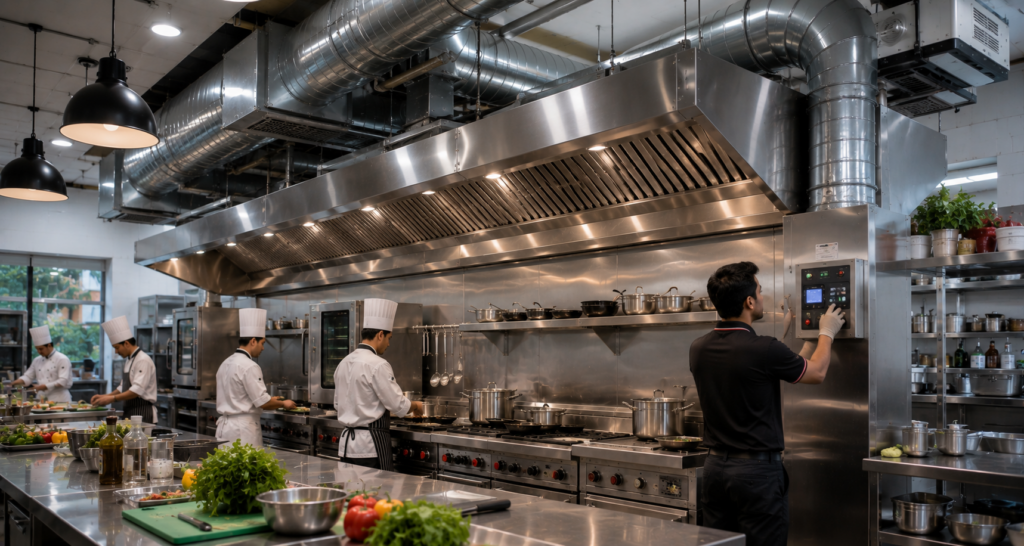
The different types of commercial kitchens will have different ventilation options.
Canopy Hood Ventilation
Canopy Hoods are common installations over cooking lines. They are ideal in use in restaurants, hotels, cafes, and a variety of other commercial food services.
They cover multiple cooking appliances and can be tailored depending on the design of the kitchen.
Wall-Mounted Exhaust Hood
This is a hood installation against a wall above the cooking appliances. It could be ideal where the cooking appliances are mounted on the wall.
Island Hood
This is an island installation of a hood over cooking appliances installed at a distance from the wall. This type usually needs good airflow management since the hood can take air from all directions.
Condensate Hood
These are condensate or steam hoods which can be used where there is heavy steam production. They may be beneficial in areas like steamers and dishwashers.
Fresh-Air Ventilation
This system provides fresh air to the kitchen to replace exhaust air. Fresh air ventilation systems are critical especially in big commercial kitchens with higher exhaust demands.
How to Choose the Right Commercial Kitchen Ventilation System
Ventilation equipment must not only depend on the size of the kitchen. Other factors need to be considered.
Think About Your Cooking Appliances
First of all, determine all major appliances such as:
- Commercial ovens
- Deep fryers
- Grills
- Ranges
- Griddles
- Steam cookers
- Tandoors
- Boilers
Each appliance creates a different amount of heat, grease, smoke, and steam.
Consider the Kitchen Layout
The position of cooking equipment is important since it affects the installation of the hood and routing of the ducting. The best thing would be to take into account the ventilation system when the kitchen is being designed rather than adding it to the already installed equipment.
Establish Airflow Requirements
Airflow depends on many factors like cooking equipment, hood size, kitchen layout, and operation mode.
Instead of choosing the fan size, it would be better to ask a professional ventilation designer to calculate airflow requirements.
Check the Space for Ducting
Ducting requires enough space both for installation and maintenance. It should be thought of even before planning the kitchen layout.
Think About Noise Levels
Noisy exhaust fans may create unpleasant conditions for work. Choosing proper equipment and designing proper ducting will help to manage excessive noise.
Benefits of a Properly Designed Ventilation System
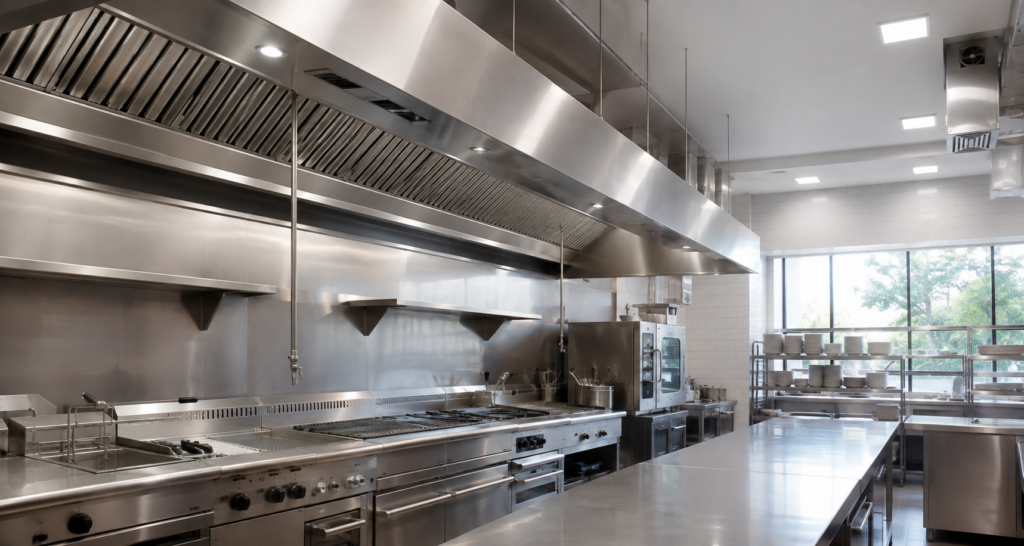
Investing in a good commercial kitchen ventilation system design will bring about various advantages.
Enhanced working environment: Minimized heat, smoke, and odors ensure an improved working environment for the kitchen employees.
Enhanced performance of kitchen equipment: Management of excess heat and moisture can ensure an improved operating environment around the kitchen equipment.
Improved cleanliness in the kitchen: Adequate extraction will ensure that there is minimal grease in the air.
Better energy management: Efficient airflow will minimize ventilation losses and thus improve the operations of the kitchen.
Improved safety in the kitchen: Adequate grease extraction and maintenance will ensure improved safety in the commercial kitchen.
Maintenance Tips for Commercial Kitchen Ventilation System
Even the best designed and installed ventilation system needs regular maintenance.
Regular Cleaning of Grease Filters
The grease filters need to be checked and cleaned as per the quantity and conditions of work in the kitchen.
Examining of Exhaust Fans
It is necessary to check for any unusual sounds, vibrations, and dirt accumulation in order to determine if the fans are not working properly.
Cleaning of Exhaust Ducts
There may be some dirt accumulation in the exhaust ducts. The professional cleaning is necessary in order to maintain proper safety in the kitchen.
Checking of Air Flow
If smoke and heat are getting accumulated around the cooking appliances, then there is a problem with air flow.
Inspection of the Whole System
Regular inspections need to cover hoods, filters, fans, ducts, make-up air systems, controls, and exhaust systems.
Common Mistakes to Avoid
Several errors may hinder the effectiveness of ventilation.
The first one is ‘installing an undersized exhaust fan’, which may cause smoke and heat to stay inside the kitchen due to insufficient airflow. The second one is ‘poor hood positioning’. If the hood does not cover the cooking equipment properly, contaminants may go into the room. Thirdly, ‘ignoring make-up air’ can cause negative pressure and affect ventilation performance. Finally, ‘neglecting maintenance’ can cause the accumulation of grease, reduction of airflow, increase of energy costs and even some safety problems.
Commercial Kitchen Ventilation in Various Businesses
Every food-service establishment has its own requirements for ventilation.
For instance, a restaurant which uses a lot of frying and grilling requires a high-capacity grease exhaust system. However, the requirements in a bakery can differ since its main problems can be associated with heat, steam and baking emissions. Hotels and institutional kitchens usually use a lot of cooking lines simultaneously and may need large and precisely zoned ventilation systems.
Ventilation will also be useful in a cloud kitchen since several cooking stations can work in a relatively small space.
Thus, ventilation must be considered based on the real cooking process and equipment.
Why Professional Planning Matters
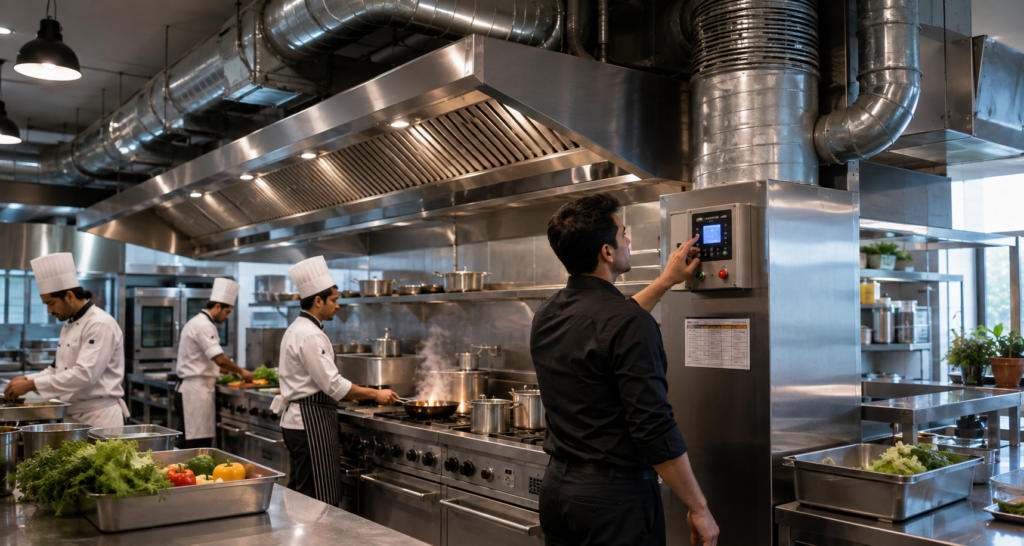
Ventilation system design goes hand-in-hand with kitchen layout design, cooking equipment selection, electrical installation, structure of the building, fire safety measures, and air quality indoors. A professional approach to planning will help you integrate all of these aspects into a functional whole.
A professional kitchen equipment manufacturer or a ventilation expert can give you proper advice on the size of the hood, exhaust requirements, ducts, filtration and fresh air requirements, etc.
Final thoughts
A commercial kitchen ventilation system is a vital element of a comfortable, safe and professional kitchen. Exhaust hoods, grease filters, fans, ducting systems, and make-up air systems – everything contributes to the management of heat, smoke, grease, steam, and smells.
When purchasing the ventilation equipment for your commercial kitchen, make sure you consider your cooking appliances, kitchen layout, ventilation requirements, space for installing the ducting system, etc. Proper design and maintenance of ventilation systems can help you improve conditions in the kitchen while maintaining safety and efficiency.
Ventilation should be one of the priorities when planning your commercial kitchen, whether it is a restaurant, hotel, bakery, cloud kitchen or cafeteria.
Frequently Asked Questions
1. What is the main purpose of a commercial kitchen ventilation system?
Its primary purpose is to remove heat, smoke, grease, steam, odors, and other airborne contaminants generated during cooking while helping maintain suitable indoor air quality.
2. How often should commercial kitchen exhaust filters be cleaned?
Cleaning frequency depends on cooking volume, equipment type, and grease production. High-volume kitchens generally require more frequent cleaning than low-volume operations. Filters should be inspected regularly and cleaned whenever grease buildup becomes noticeable.
3. Does every commercial kitchen need a make-up air system?
Not necessarily as a standalone system, but adequate replacement air is important whenever significant exhaust air is being removed. The appropriate solution depends on the building and ventilation design.
4. Can one exhaust hood cover all kitchen equipment?
It depends on the equipment arrangement and the type of cooking being performed. The hood must provide suitable coverage for the appliances that generate heat, smoke, grease, or steam.
5. What happens if a kitchen has poor ventilation?
Poor ventilation can result in excessive heat, lingering smoke, unpleasant odors, grease accumulation, uncomfortable working conditions, and reduced indoor air quality. It can also create airflow and safety issues.
6. How can I improve the efficiency of my kitchen ventilation system?
Regularly clean filters, maintain exhaust fans, inspect ductwork, keep exhaust paths clear, ensure adequate replacement air, and have the system professionally inspected when performance declines.