
Choosing the appropriate industrial oven for your food and retail business can now affect the general cooking process, effort efficiency, and kitchen outcome. If you own a restaurant, bakery, motel, cafe, or cloud kitchen, it is an essential advantage to know the difference between gasoline and electric models. Both types of commercial ovens have distinct advantages; however, the right preference will depend on your cooking desires, budget range, and kitchen layout.
In this brochure, we can explore commercial furnaces that run on gasoline or natural gas, which will help you make an informed choice.
What is a processing furnace?
Commercial ovens are heavy-duty kitchen appliances designed for the expert chef. They are designed to address the responsibilities of cooking, baking, frying, and overeating. Compared to residential ovens, commercial ovens offer added robustness, faster cooking, all-around performance, and added temperature changes.
The two most unusual types are gasoline- and electric-powered commercial stoves.
Gas Commercial Ovens: Benefits and Features
Gas-commercial furnaces use natural gas or LPG as the primary fuel source. They are widely used in restaurants, hotels, and busy catering establishments.
Benefits of Gas Commercial Furnaces
1. Faster heating performance
Gas commercial furnaces generally heat faster than their electric counterparts. This makes them ideal for kitchens that require continuous cooking for a period of full company day.
2. Reducing operating expenses
Gas is also cheaper than electricity in many areas. Ultimately, fuel-cell industrial furnaces can reduce application prices over time for high-volume operations.
3. Better in high-volume cooking
Restaurants and catering companies often decide to use gas commercial ovens because they recover heat quickly and help with non-stop cooking.
4. Reliability during power fluctuations
Some gas commercial ovens can keep running through power interruptions, making them desirable for positive business kitchens.
Disadvantages of Electric Commercial Ovens
- Installation may additionally require fuel pressurization and proper ventilation.
- Temperature control will not be as unique as electric models.
- Once-a-year maintenance can be extra complicated.
Electric Commercial Ovens: Benefits and Features
Electric industrial ovens run on electricity and are often used in bakeries, cafes, and catering businesses that require complete temperature control.
Benefits of Electric Commercial Ovens
1. Precise Temperature Control
Electric industrial ovens are recognized for providing a consistent and accurate temperature. This feature is especially important for baking cakes, pastries, breads, and delicate dishes.
2. Easy Installation
Unlike gas appliances, electric-powered commercial ovens typically do not require fuel lines, making installation less difficult in many commercial settings.
3. A cleaner cooking environment
Electric commercial ovens regularly produce less ambient heat, contributing to creating a more comfortable cooking environment.
4. Ideal for baking
Bakery and confectionery groups often choose electric-powered commercial ovens because of their more even heat distribution and reliable bakes.
Damage to electric industrial furnaces
- The cost of electricity can be good in certain places.
- Compared to gas models, the heating treatment can be slower.
- Dependence on power distribution can be a barrier to power outages sometimes.
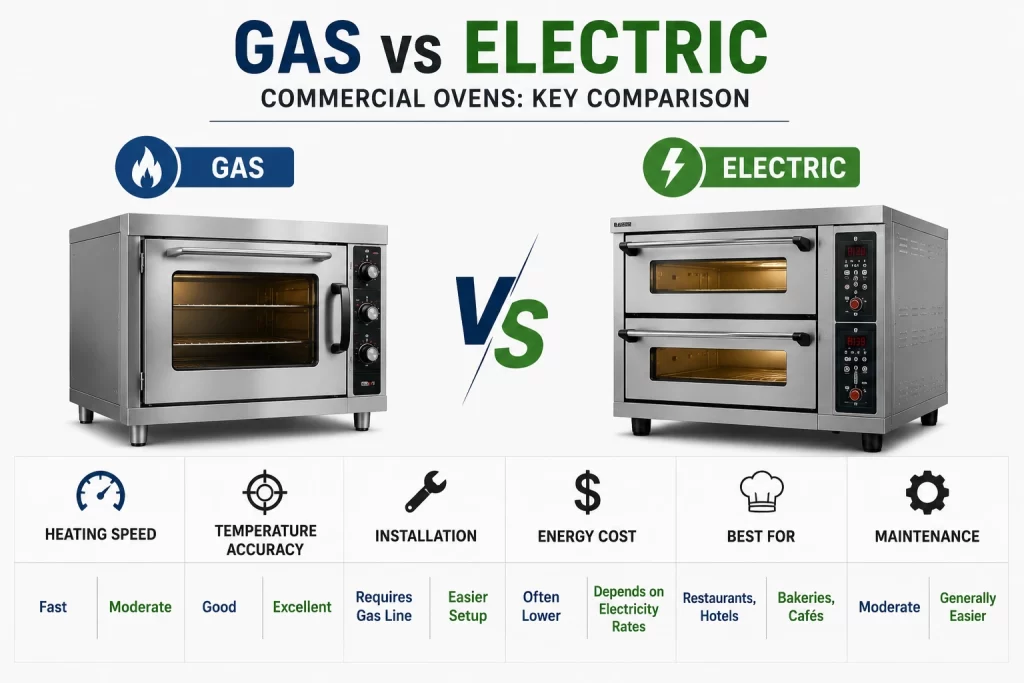
Gas vs Electric Commercial Ovens: Key Comparison
When deciding between gas and electric commercial furnaces, consider their overall performance, cost, and business benefits.
Heating Speed:
Gas-commercial ovens heat up quickly, while electric fashion cooking also provides an overall performance.
Thermal accuracy:
Gas-powered industrial ovens provide precise control, while electric-powered industrial ovens provide extra specific heat.
Setup:
Gas industrial furnaces require fuel connections and ventilation. Electric industrial ovens are simpler to install.
Energy costs:
Gas-powered commercial furnaces typically have lower operating costs, and electric-powered rates are subject to electricity rates.
Good Applications:
Gas commercial stoves are suitable for restaurants and motels. Electric industrial ovens are ideal for bakeries and cafes.
Maintenance:
Gas commercial ovens require soft protection, while electric commercial ovens are generally less complicated to install.
Understanding these differences helps businesses choose the most appropriate commercial furnace for their operations.
Which Commercial Ovens Are Best for Your Business?
The right commercial ovens depend on your commercial business type and the style of cooking.
Choose a gas commercial furnace if you:
- Running a busy restaurant or hotel kitchen
- Rapid heating and short curing time are required
- Want to reduce gas costs in over-extended cooking environments
Choose an electric commercial oven if you:
- Run a bakery, cafe or pastry shop
- Strict temperature stability is required
- Probably simpler setup and controlled baking results
Final Thoughts
Choosing between fuel-burning and electric commercial furnaces is not always a one-size-fits-all choice. Both options offer valuable benefits depending on your operational preference. Gas industrial ovens are great for speed, efficiency, and large-scale cooking, while electric industrial ovens stand out for precision, consistency, and baking
Check the menu, kitchen infrastructure, power supply, and finances before buying a commercial oven. Investing in the right tools can improve productivity, meal exceptions, and general business enterprise performance.
Knowing the strength of commercial ovens in fuel and electricity, you could optimistically choose a unique solution in your professional kitchen.